What to Do When Signal Is Lost: Backup Control Scenarios for Unmanned Systems | Global Mark
What to Do When Signal Is Lost: Backup Control Scenarios for Unmanned Systems
Modern unmanned systems operate in environments where maintaining a stable communication link cannot always be guaranteed. Electronic Warfare (EW), challenging terrain, adverse weather conditions, or technical failures may interrupt communication between the operator and the platform.
To ensure mission continuity and platform survivability, modern unmanned systems are equipped with backup control scenarios that enable autonomous decision-making when the primary communication channel is lost.
Why Does Signal Loss Occur?
Communication between the operator and an unmanned platform may be disrupted due to several factors, including:
- Electronic Warfare (EW) interference;
- Exceeding the operational communication range;
- Natural or urban obstacles;
- Complex terrain;
- Severe weather conditions;
- Antenna or hardware damage;
- Electromagnetic interference.
Regardless of the cause, every unmanned mission should include predefined contingency procedures before takeoff.
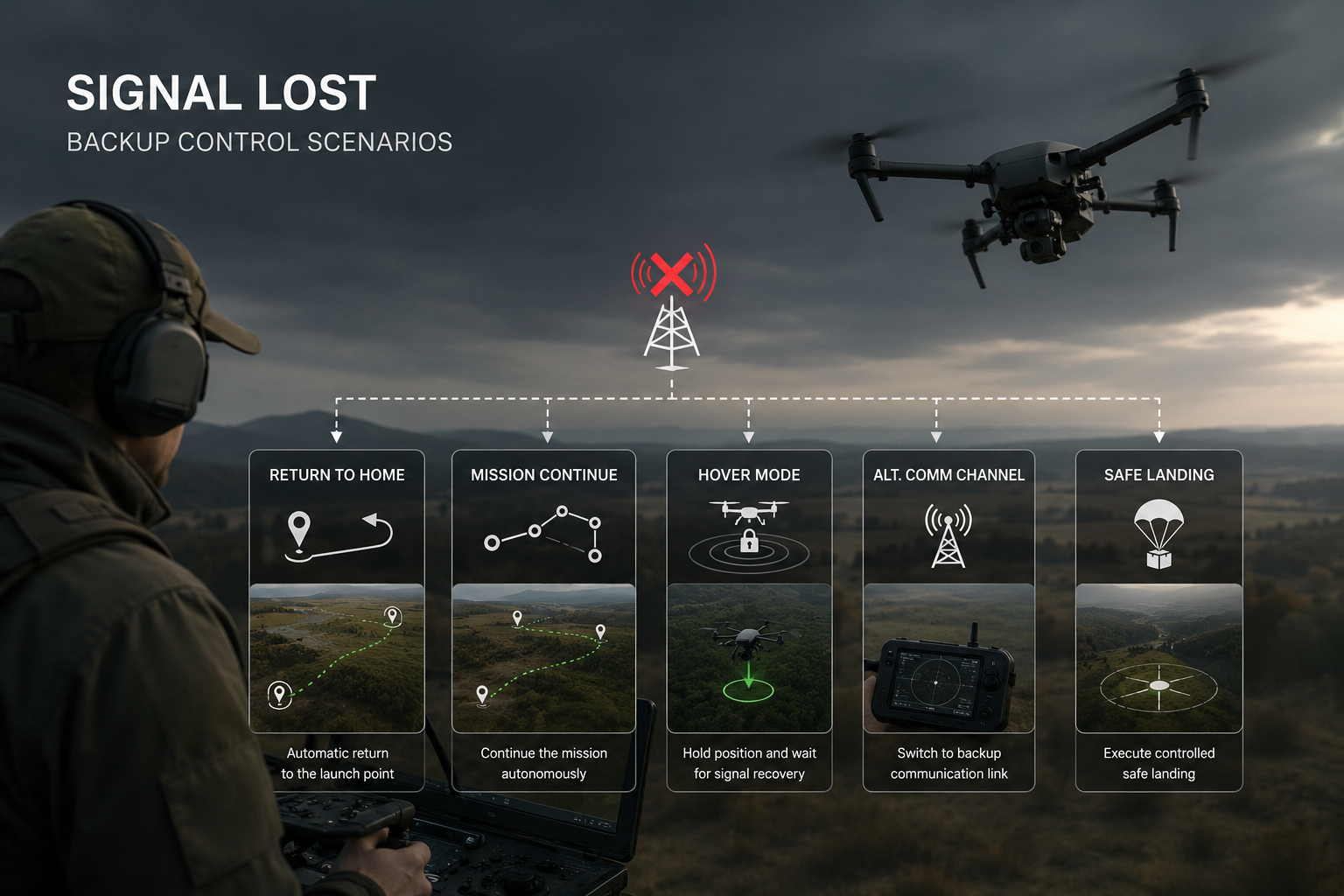
Return to Home (RTH)
One of the most important safety features of modern unmanned platforms is Return to Home (RTH).
If communication with the operator is interrupted, the autopilot automatically switches to a predefined recovery mode and navigates the platform back to its launch point or another designated location. During this process, the system continuously evaluates flight altitude, navigation data, battery level, and mission parameters.
Key Advantages
- Automatic recovery without operator intervention;
- Reduced risk of platform loss;
- Increased operational safety;
- Minimized human error.
Autonomous Mission Execution
Modern unmanned systems increasingly rely on autonomous mission capabilities.
If the mission route has been uploaded before launch, the platform can continue operating even without an active communication link.
The autopilot is capable of:
- following predefined waypoints;
- performing reconnaissance missions;
- collecting operational data;
- conducting surveillance tasks;
- returning to the recovery point upon mission completion.
This capability is particularly valuable in environments where Electronic Warfare systems actively disrupt communications.
Switching to a Backup Communication Channel
Advanced unmanned platforms often incorporate multiple independent communication systems.
Depending on the mission profile, backup connectivity may include:
- secondary digital radio links;
- encrypted communication channels;
- satellite communication systems;
- fiber-optic control links for FPV platforms.
Automatic channel switching significantly improves platform survivability in contested electromagnetic environments.
Position Hold Mode
If signal loss is temporary, the unmanned platform may enter a stable Position Hold mode.
Once communication is restored, the operator can immediately resume mission control without initiating a recovery procedure.
This mode is particularly effective during short-term signal interruptions or temporary EW activity.
Controlled Emergency Landing
If returning to the launch point is no longer possible due to low battery, navigation failure, or other critical conditions, the autopilot initiates a controlled emergency landing.
Before making this decision, the system evaluates:
- remaining battery capacity;
- current coordinates;
- flight altitude;
- airspeed;
- availability of a safe landing area.
The objective is to preserve both the platform and its payload whenever possible.
Pre-Flight Preparation
Reliable contingency procedures begin with proper mission planning.
Before every deployment, operators should:
✔ verify primary and backup communication channels;
✔ test the Return to Home function;
✔ configure safe recovery altitude;
✔ inspect antennas and communication hardware;
✔ confirm battery status;
✔ update flight control software;
✔ assess the expected Electronic Warfare environment.
Why Backup Control Scenarios Matter
Modern defense operations demand highly resilient unmanned systems capable of operating in contested environments.
Backup control scenarios are no longer optional—they have become a fundamental requirement for professional unmanned platforms.
By combining secure communication links, autonomous navigation, intelligent flight control algorithms, and multiple contingency modes, operators can significantly improve mission success while reducing the risk of platform loss.
Conclusion
Signal loss does not necessarily mean mission failure.
Modern unmanned systems are designed to continue operating safely through autonomous navigation, backup communication channels, intelligent recovery procedures, and advanced flight control algorithms.
A comprehensive approach to platform design—including resilient communications, autonomous capabilities, and reliable contingency planning—ensures greater operational effectiveness in today's complex defense environment.