Photon Automatic Guidance System: Operating Principle and Advantages
How the PHOTON Automatic Guidance System Works
Modern technology is transforming the way precision and autonomy are achieved in guided systems. One such development is the PHOTON automatic guidance system — an innovative solution that uses optical and digital methods to accurately detect targets and adjust movement in real time.
PHOTON is designed as a universal platform combining computer vision, sensor modules, and image-processing algorithms. This allows the system to operate effectively in challenging conditions — low light, fog, or partially obstructed visibility.
Core Operating Principle
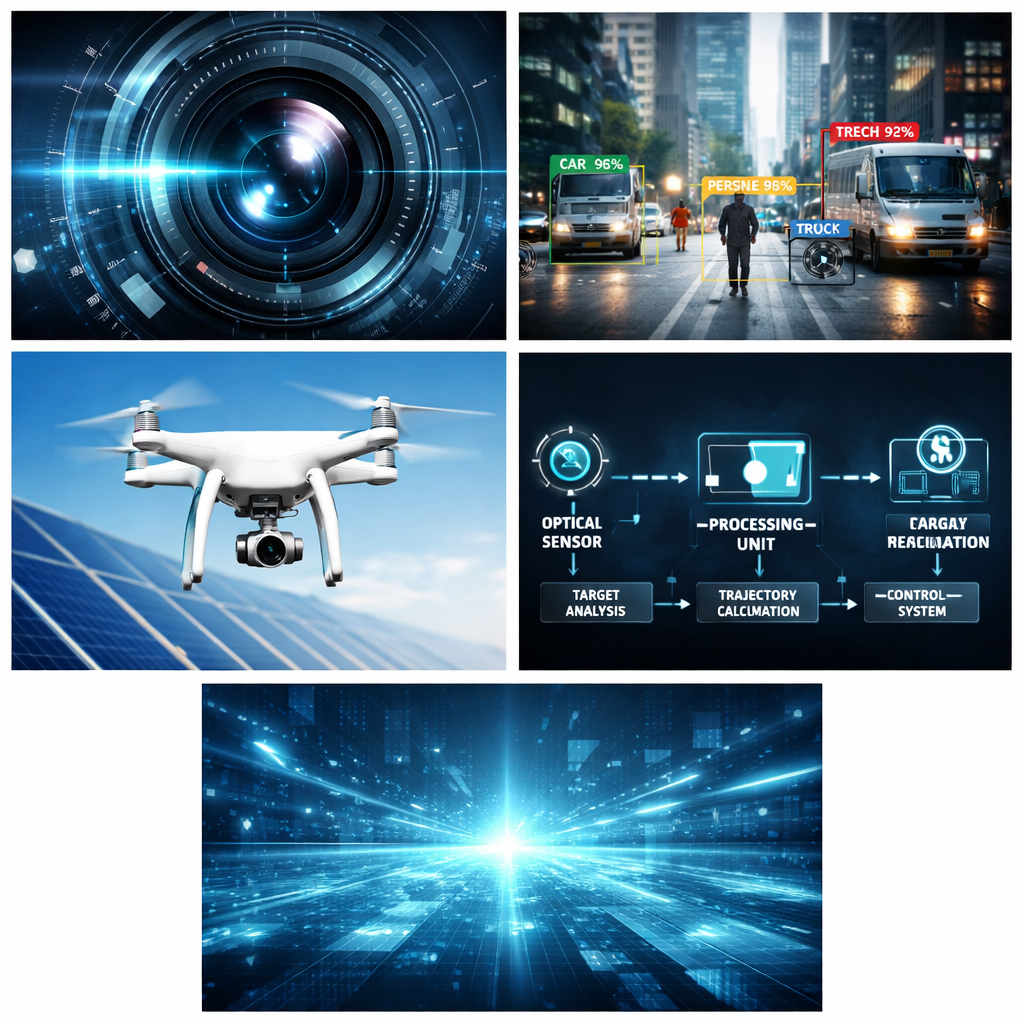
At the heart of PHOTON is an optical observation unit. It captures visual information about the surrounding environment and transmits it to a digital processor. The software then analyzes the image, identifies the designated target, and determines its coordinates.
After detecting an object, the system:
- Recognizes contours and key features of the target
- Determines its position in space
- Calculates movement trajectory
- Sends correction commands to the control module
All of this happens in fractions of a second, ensuring high precision and stable operation.
Computer Vision and Artificial Intelligence
A key feature of PHOTON is the use of machine-learning algorithms. They enable the system to:
- Distinguish the target from background noise
- Track moving objects
- Adapt to changing lighting conditions
- Reduce false detections
As a result, PHOTON doesn’t simply “see” — it analyzes the situation, significantly improving guidance accuracy.
Another important component is the stabilization module. It compensates for vibration, platform movement, or positional changes of the system. This ensures precise tracking even when the carrier platform is in motion. The system continuously updates target position data and applies real-time corrections, providing smooth and uninterrupted guidance. PHOTON offers several advantages over traditional guidance systems: These qualities make the system promising for various fields — from robotics and industrial automation to scientific and unmanned platforms. Further development of PHOTON focuses on increasing image-processing speed, improving artificial intelligence performance, and reducing energy consumption. In the future, such systems will be able to analyze complex environments even more accurately and operate with minimal human involvement. PHOTON demonstrates how combining optics, electronics, and artificial intelligence creates a new level of automatic guidance technology. With its ability to “see” and “understand” the environment, the system opens broad possibilities for next-generation autonomous solutions.Stabilization and Continuous Correction
Advantages of PHOTON Technology
Future Development
Conclusion